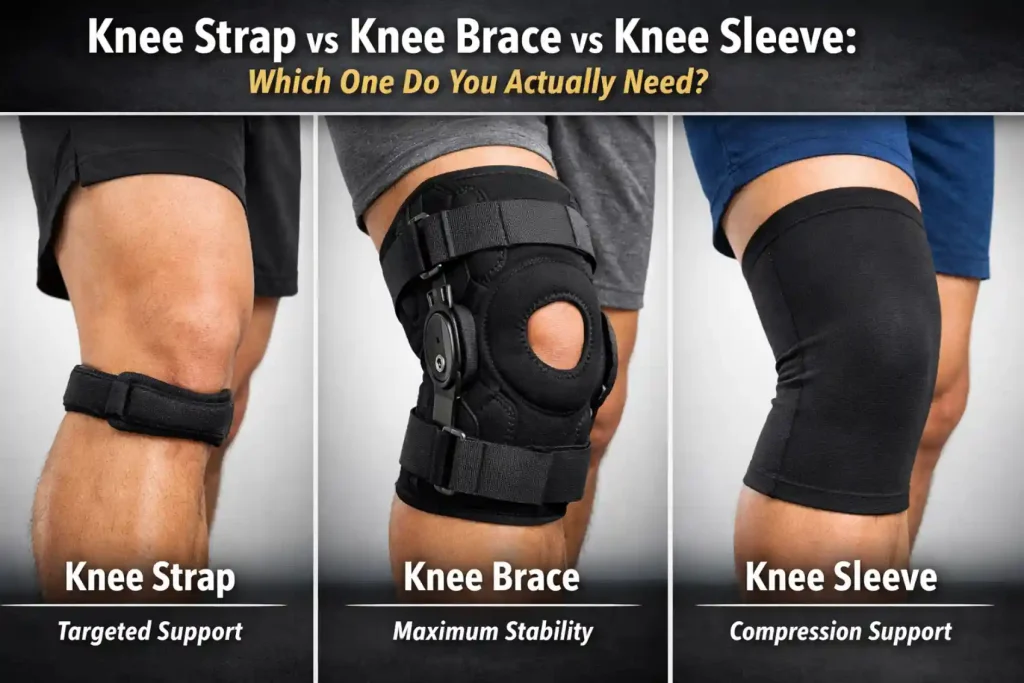
Knee supports look similar from the outside, but underneath they are three different products doing three different jobs. A knee strap puts targeted pressure on a narrow area below the kneecap — useful when discomfort is focused on the patellar tendon. Knee sleeve wraps the whole joint in 3–7mm of compression material — useful when you want warmth, mild support, and continuous feedback. A knee brace adds rigid structural elements like hinges or reinforced panels — useful when the knee needs real mechanical control, not just compression.
This guide walks through what’s actually inside each product, when each one is the right fit, and what to do when none of them is enough on its own.
| Support type | Main support style | Coverage | Best for | Less suitable for | Feel during wear |
|---|---|---|---|---|---|
| Knee strap | Targeted pressure | Below the kneecap | Patellar tendon area discomfort, jumping, running | Broad knee discomfort, instability, swelling | Small, light, focused |
| Knee sleeve | Compression and mild support | Around the joint | Daily wear, gym use, mild support, warmth | Pinpoint patellar tendon pain, joint instability needing structural control | Soft, even, easy to wear |
| Knee brace | Structured support and more control | Wider joint area | Instability, stronger support needs, return-to-activity support | Mild general soreness, hot-weather activity, low-profile daily wear | Bulkier, more supportive |
What is the real difference between a knee strap, knee sleeve, and knee brace?
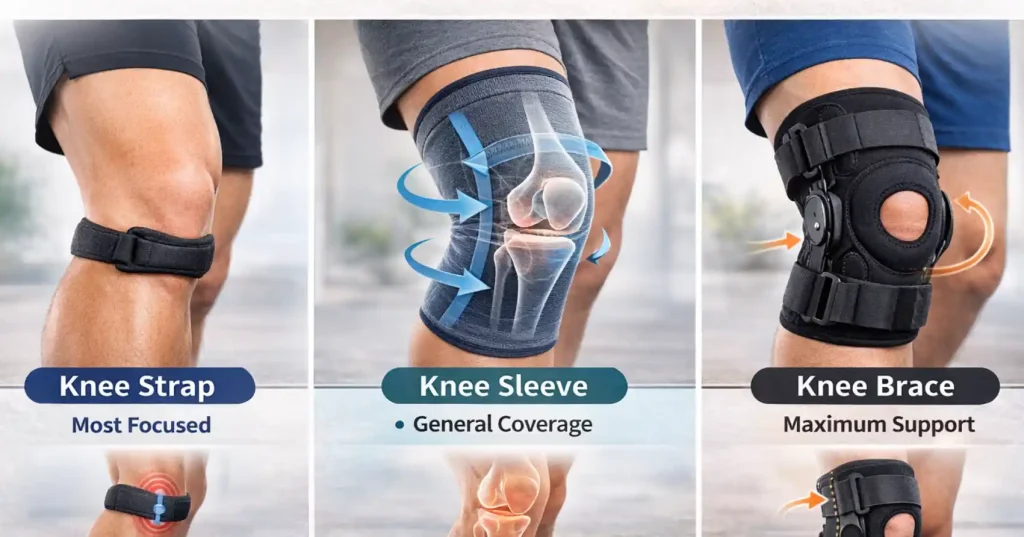
The three products look similar from the outside but are built differently underneath. Here’s what each one is, in concrete terms.
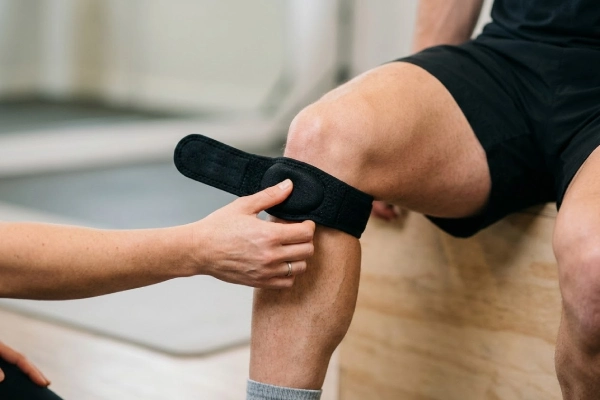
Knee strap. A narrow band of elastic webbing — typically 25–50mm wide — with a raised pad or pressure cushion built into the inner surface. It wraps around the leg just below the kneecap and applies focused pressure on the patellar tendon area. There are no joints to cover and no thickness across the whole knee. Just a narrow band doing one specific job.
Knee sleeve. A tube of stretchable material — usually neoprene at 3mm, 5mm, or 7mm thickness, or a knit blend of nylon, polyester, and elastane. It slides on like a long sock and covers the joint from above the kneecap to below the calf attachment. The material has a Young’s modulus of roughly 2–5 MPa, which gives enough stretch to follow knee flexion while applying mild even compression — typically in the 15–25 mmHg range for athletic sleeves.
Knee brace. Structurally different from both. A brace contains rigid or semi-rigid elements: metal or polymer hinges, side stays, reinforced panels, or unloader frames. Those elements do something the other two cannot — they mechanically influence how the knee moves and how load travels through the joint. A brace can restrict certain directions of motion, redirect force away from a painful compartment, or stabilize a ligament that can’t fully do its job. From a material standpoint, the brace is the only product in this category that genuinely transfers mechanical load through a structural frame.
In our experience producing all three categories, the most consistent misunderstanding is the assumption that “more material around the knee” means “more support.” A 7mm neoprene sleeve has far more material than a 25mm-wide patella strap, but the strap delivers more focused mechanical pressure to its target area. Coverage isn’t support.
If you want the longer breakdown of strap variations specifically, our knee strap guide covers fit and design detail.
When does a knee strap make more sense than a sleeve or brace?
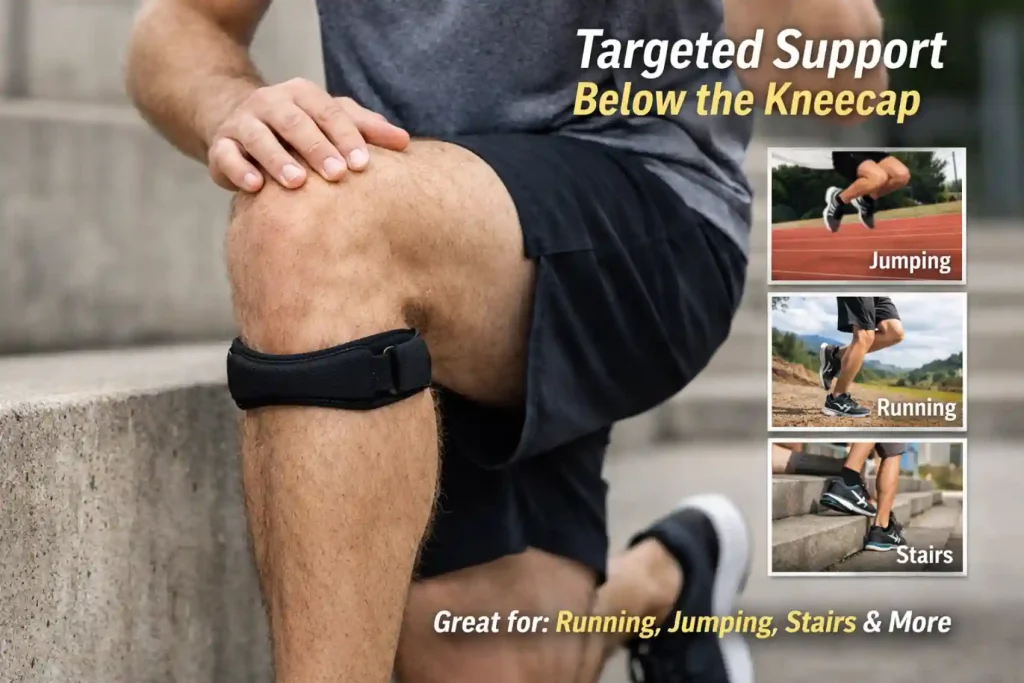
When discomfort is focused below the kneecap
A knee strap is the right answer when the pain pattern points to one specific structure: the patellar tendon — the band of tissue running from the kneecap to the shinbone. This shows up as discomfort during jumping, landing, climbing stairs, deep squats, or running on hard surfaces. The pain tends to be localized — you can usually point to it with one finger, right below the kneecap.
A sleeve covers this area too, but spreads pressure across the whole knee, which dilutes what you need. A brace controls motion, but the issue here isn’t motion — it’s load on a specific tendon. A strap applies pressure exactly where the problem is.
When you want minimal bulk and full freedom of movement
A strap weighs almost nothing and stays out of the way during fast movement. Runners and basketball players who can’t tolerate a full sleeve in summer often default to a strap for the same reason — heat. A 7mm neoprene sleeve traps warmth, which is helpful for joint preparation but uncomfortable in hot weather or during sustained high-effort activity. A strap leaves the rest of the knee uncovered.
“Patella strap,” “patella band,” “patellar tendon strap” — are these the same product?
Yes. These terms all refer to the same product category. Different brands and different countries use different names, but the underlying product is the same: a narrow elastic band with a pressure pad that sits below the kneecap. You’ll see them sold as patella straps, patella bands, patellar straps, patellar tendon straps, jumper’s knee straps, or knee straps. Variations within the category are mainly about width (typically 25–50mm), single-band vs. dual-band designs, and adjustability — not about fundamental function.
What a knee strap cannot do
A strap cannot do what the other two products do. It does not warm or compress the whole joint. It does not stabilize a wobbly knee. It does not control motion after a ligament injury. If the issue is joint-wide soreness, generalized instability, or recovery from a structural injury, a strap will feel undersized for the problem.
If fit is part of the problem, see how a patella knee strap should sit below the kneecap. If you’re not sure whether a strap actually helps your pain pattern, what patella straps actually do for knee pain walks through the evidence.
When is a knee sleeve the better choice?
A knee sleeve is the right choice when you want continuous, mild support across the entire joint rather than focused pressure on one area. This fits most everyday use cases: gym sessions where multiple movements stress the knee differently, walking or hiking where you want gentle warmth and proprioceptive feedback, recovery days when the joint feels generally tired rather than specifically painful, and long stretches on your feet where mild compression helps with venous return.
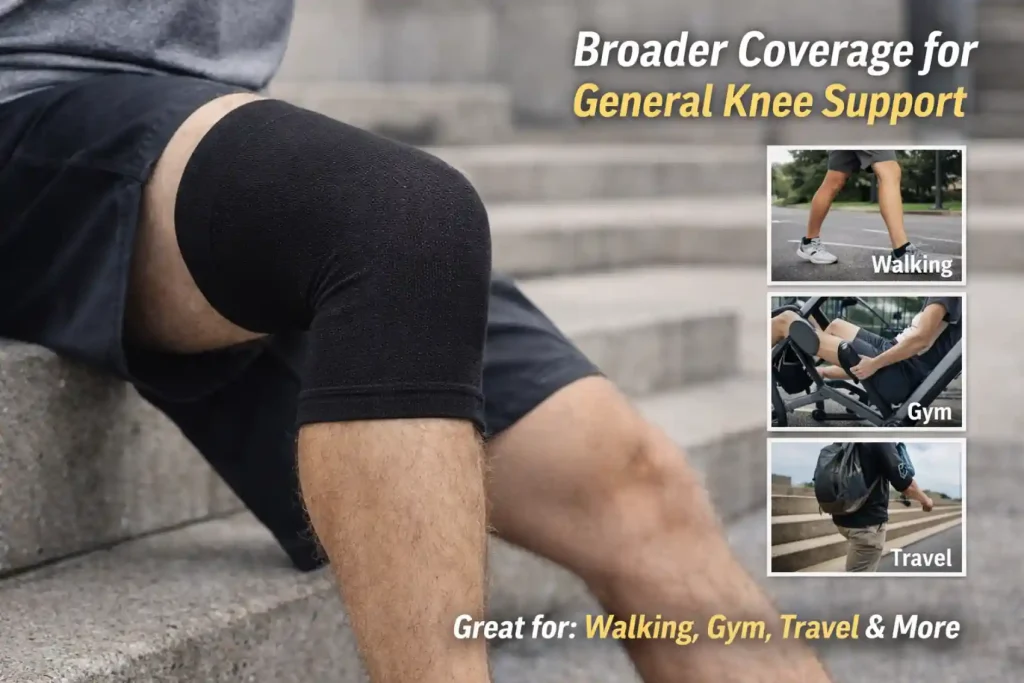
A sleeve also makes sense when you want a product you can forget about. It slides on once and stays put — no positioning every few minutes, no rebuckling, no checking that the pressure pad is sitting on the right spot.
There’s an important non-effect worth naming directly: a knee sleeve will not weaken your knee or cause muscle atrophy. The material is too soft to substitute for muscle work. The mechanical reasoning behind that is the subject of a separate piece — worth reading if the worry has been holding you back.
Thickness affects feel more than function: 3mm sleeves run cool and disappear under clothes, 5mm sleeves are the most common all-around choice, and 7mm sleeves give the most warmth and perceived firmness. Our guide to 5mm vs 7mm knee sleeves walks through the trade-offs. Fit matters more than thickness — a sleeve that’s too tight does more harm than a thinner one that fits well, so check the sizing guide before ordering.
For the longer read on what a sleeve actually does mechanically, see our complete guide to knee sleeves.
When is a knee brace the better choice?
A knee brace earns its place when the knee needs mechanical control, not just compression or pressure. The key word is control — control of how far the knee bends, how it tracks during movement, or how load distributes across the joint surfaces.
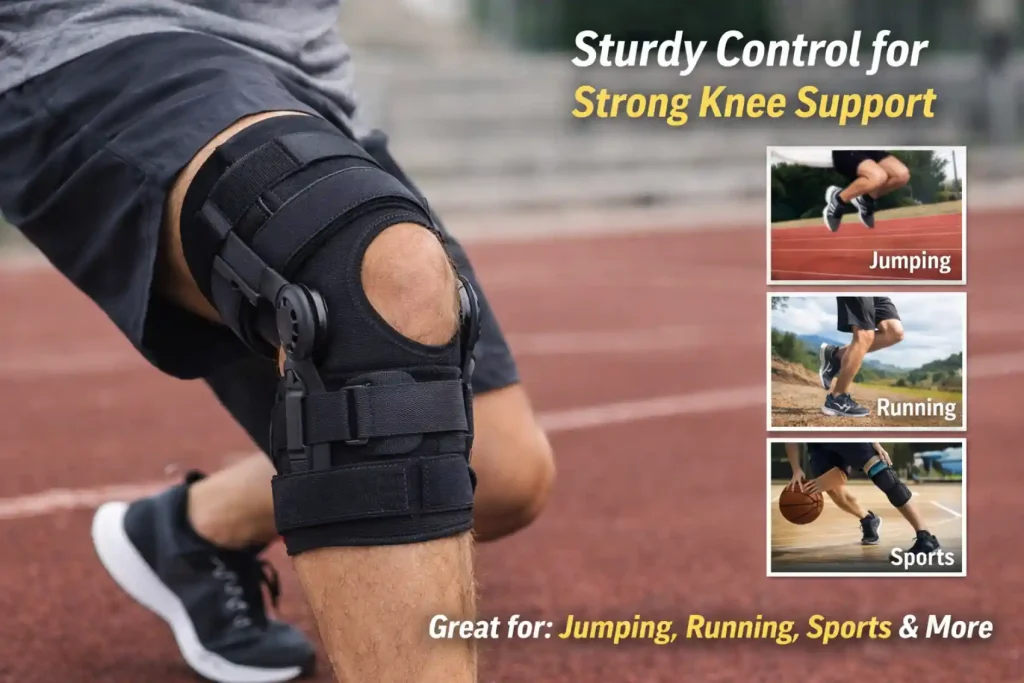
Common situations include returning to activity after a ligament injury (ACL, MCL, PCL), managing instability that makes the knee feel like it might “give way,” recovering after meniscus surgery, and offloading a specific compartment in unilateral knee osteoarthritis.
Braces vary widely in structure, and understanding the sub-types helps with shopping:
- Wraparound braces open up and wrap around the leg, fastened with hook-and-loop straps. Easier to get on, useful when sliding a sleeve over a swollen knee is uncomfortable.
- Pull-on hinged braces combine sleeve-like fabric with metal or polymer hinges on the sides. Hinges provide medial-lateral stability while allowing flexion and extension.
- Functional braces are the rigid braces prescribed after ACL reconstruction — substantial frames designed to limit specific motion patterns.
- Unloader braces redirect force away from one side of the joint, used in single-compartment knee osteoarthritis. Almost always clinician-fitted.
- Prophylactic braces are worn by uninjured athletes (often football linemen) to reduce injury risk during contact sports.
A brace is almost always overkill for general gym soreness or mild discomfort. The bulk, heat, and restriction become a real cost — only worth paying when the support need genuinely calls for them.
Quick scenario lookup: matching your situation to the right support

| Your situation | Best first choice | Why |
|---|---|---|
| Pain right below the kneecap during running or jumping | Patella strap | Targets the patellar tendon without unnecessary coverage |
| General knee soreness during or after gym workouts | Knee sleeve (5mm) | Broad compression and warmth across the joint |
| Knee feels stiff and cold during winter activity | Knee sleeve (7mm) | Maximum warmth retention with mild compression |
| Returning to activity after ACL or other ligament reconstruction | Functional knee brace (with physical therapy guidance) | Mechanical control during rehab return |
| Knee that occasionally “gives way” without clear injury history | Hinged knee brace + see a clinician | Stability while the underlying cause is assessed |
| Knee osteoarthritis affecting one side of the joint | Unloader brace (clinician-fitted) | Redirects load away from the affected compartment |
| Long shifts standing or walking with mild swelling | Knee sleeve (3–5mm) | Mild compression supports venous return without heat buildup |
| Football, basketball, volleyball with healthy knees | Optional sleeve for warmth, or strap if patellar tendon is bothered | Most healthy athletes don’t need bracing |
| Recovery from meniscus surgery | Brace early, sleeve later (per surgeon’s protocol) | Brace for early protection, sleeve during return-to-activity phase |
When is none of them enough on its own?
A strap, sleeve, or brace can make a knee feel better while you use it. None of them can diagnose what’s wrong, and none of them can replace rehabilitation when rehabilitation is what the knee actually needs.
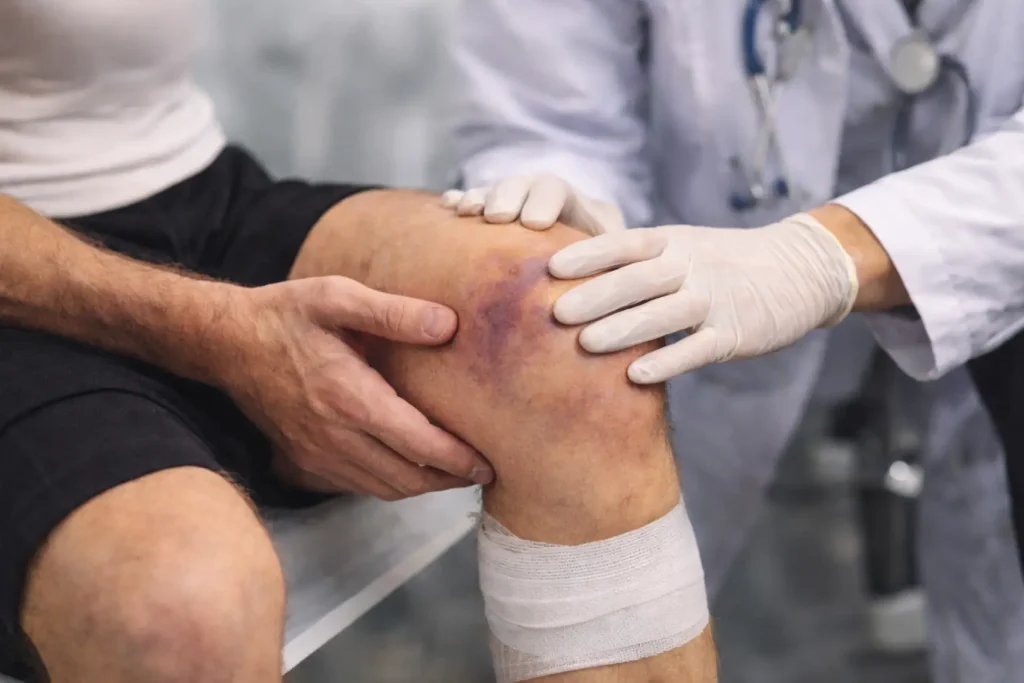
The signs that you’ve moved past “pick the right support” territory and into “see someone qualified” territory:
- The knee swells significantly after activity, or stays swollen
- It locks, catches, or feels like something is moving inside it
- It gives way without warning, especially during planted-foot movements
- Pain stays sharp even at rest, or wakes you at night
- The knee looks visibly different from the other one
- Symptoms are getting worse rather than better despite reasonable rest
A knee that meets any of those criteria isn’t waiting for the right product — it’s waiting for a real assessment. A support garment used afterward, alongside proper treatment, is a useful tool. Used as a substitute for assessment, it just delays the real work. The Cleveland Clinic’s overview of knee pain is a reasonable starting point if you’re trying to decide whether assessment is needed.
How to actually choose
The decision usually comes down to where the discomfort sits and how much control the knee needs.
- If the issue is focused below the kneecap and the knee is otherwise stable → start with a patella strap.
- If you want general support, warmth, and proprioceptive feedback across the whole joint → a knee sleeve.
- If the knee needs real mechanical control — post-injury, post-surgery, or actively unstable → a knee brace, ideally selected with clinician input.
It’s also fine to use more than one product across different activities. A patella strap for runs, a 5mm sleeve for gym sessions, no support during normal daily life — that’s a reasonable combination for someone with otherwise healthy knees who has a specific running-related issue. Matching the product to the moment usually works better than picking one product to use for everything.
FAQ
Neither is universally better — they solve different problems. A strap delivers focused pressure on the patellar tendon area and is better when the pain is pinpoint and below the kneecap. A sleeve wraps the whole joint and is better when you want general warmth, mild compression, and proprioceptive feedback across the knee.
Yes — a brace contains rigid structural elements (hinges, side stays, or reinforced frames) that mechanically influence joint motion and load. A sleeve does not. “Stronger” is the right word if the goal is control. If the goal is gentle continuous support, a sleeve may still be the better fit.
Yes. Many runners choose a knee strap when discomfort is closely tied to the patellar tendon area and a lighter support feels more practical than a brace.
A strap is the typical first choice for jumper’s knee (patellar tendinopathy) because the pain pattern is focused on one structure — the patellar tendon — and a strap targets it directly. A brace is rarely needed unless there’s a separate stability issue. The strap is a comfort and load-distribution tool, not a treatment; the underlying tendon issue still needs to be addressed through loading exercises.
If your knee feels unstable, swells, locks, or becomes painful after an injury, a strap may be too limited for the real problem.
es. These are different names for the same product category — a narrow elastic band with a pressure pad that sits below the kneecap. You’ll also see “jumper’s knee strap” and just “knee strap” used the same way. Variations within the category come down to width (typically 25–50mm), single-band versus dual-band designs, and whether there’s a buckle or hook-and-loop closure.
Yes — this is a common combination for athletes who want general joint warmth plus targeted tendon support. The strap goes on first, sitting below the kneecap, then the sleeve slides over the top. Make sure neither piece is so tight that they restrict circulation when combined. If the calf goes numb or the foot starts to tingle, loosen the strap first.
For over-the-counter braces — including most wraparound and pull-on hinged designs — no prescription is needed. For functional braces used after ACL or other ligament reconstruction, and for unloader braces used in osteoarthritis, a clinician fitting is strongly recommended even when a prescription isn’t legally required. Those products work only when matched to the specific joint geometry and pathology, and a poorly chosen brace can do more harm than no brace.