Your aim can feel “off” even when your settings haven’t changed. One day your forearm glides; the next day it grabs, sticks, or skips—especially once you warm up.
The reason is simple: FPS gameplay usually requires larger and faster mouse movement, while MOBA gameplay tends to concentrate movement into smaller zones with higher-frequency micro actions. That difference changes what matters most in your setup—and whether a gaming arm sleeve helps or becomes another variable.
Non-medical note: This article shares general gaming and ergonomics information. It is not medical advice. If you have persistent numbness, pain, tingling, or known wrist/nerve conditions, consult a qualified clinician.
Why FPS and MOBA feel different on the desk
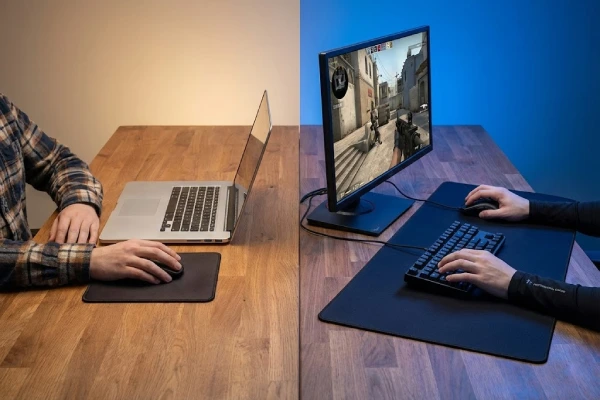
A 2025 biomechanics study measured right upper-limb movement across esports game genres using sensors on the hand, forearm, and upper arm. Compared with MOBA players, FPS players showed greater total travel distance, higher hand acceleration, and larger mousepad coverage area—in plain terms: more big, fast movement across more space.
The same research also reported a genre difference in DPI preference in that sample, with MOBA players more commonly selecting 1600 DPI than FPS players.
Practical takeaway:
- FPS: bigger movement budget → glide consistency and desk/pad space matter more.
- MOBA: concentrated movement + rapid inputs → stability at the grip/pivot matters more.
If you need a simple “how much you physically move” concept, aim trainers often use cm/360: how many centimeters you move the mouse to rotate 360° in-game. Higher cm/360 generally means lower sensitivity and more physical movement.
FPS vs MOBA setup differences at a glance
| Factor | FPS (more arm + forearm involvement) | MOBA (more wrist/fingers micro control) |
|---|---|---|
| Mouse travel | Larger, faster travel over more area | More concentrated travel area |
| Desk + pad | Benefits more from large pad + open desk space | Size matters less than stability |
| Common pivot | Forearm on desk; elbow/forearm guide big lines | Wrist/palm pivot; finger micro control |
| Biggest enemy | Variable friction (sweat, skin drag, sleeve edges) | Extra variables near grip (palm feel, cuff pressure) |
| Sleeve value | Often high: stabilizes forearm contact/friction | Often optional: comfort-first, avoid grip interference |
Common examples:
- FPS: VALORANT, Counter-Strike 2, Overwatch 2
- MOBA: League of Legends, Dota 2
FPS setup: build for repeatable glide
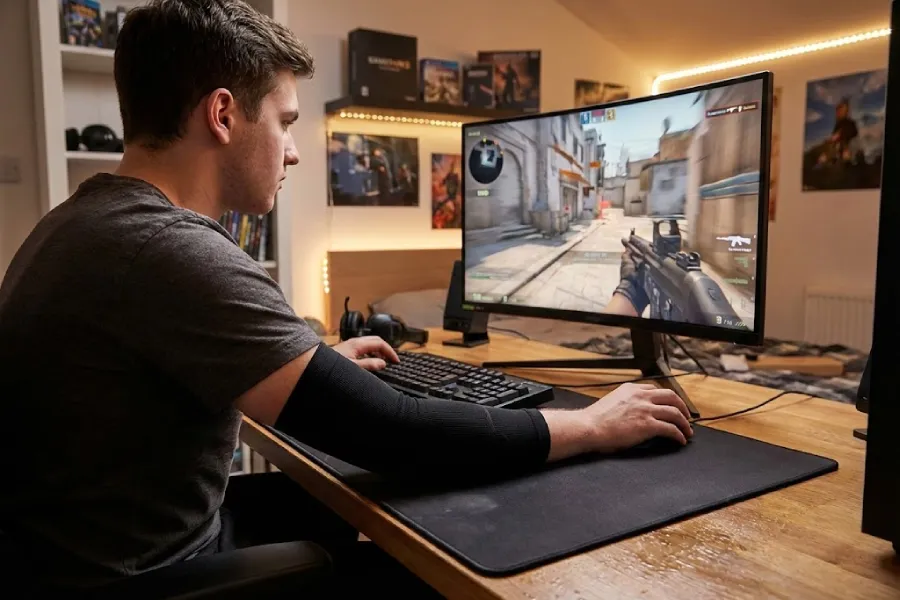
Elbow and desk height affect how vertical motions feel (straight vs arcing). A stable elbow/forearm position reduces “unplanned resistance” when you change direction fast.
Manage sweat and “arm drag” with a sleeve (when it makes sense)
This is where sleeves help the most for many FPS players: more distance and higher speed means small friction changes get amplified into inconsistent stops/starts.
A sleeve should be treated as a friction interface—not a promise of better aim. Results depend on mousepad surface, sweat, posture, and sleeve construction. For most players, the fastest way to avoid mismatch is to choose fabric based on pad type, which is why we broke down Gaming Arm Sleeve for Glass Mousepads vs Cloth Pads: How to Choose the Right Fabric.
For FPS-oriented sleeves, prioritize:
- Coverage: cover the forearm contact band (where you actually touch pad/desk).
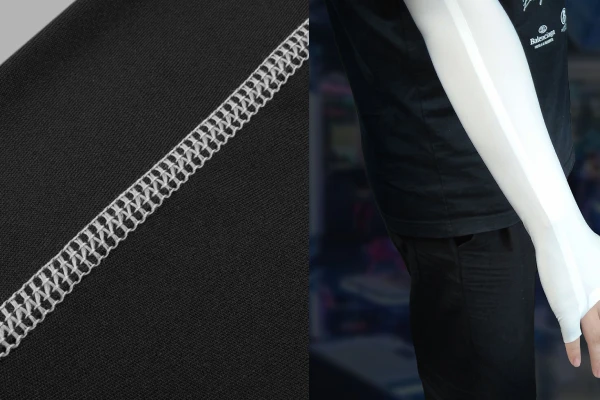
- No interruptions in the contact band: avoid seams, logos, labels, or cuff edges landing on the glide zone.
- Stable surface feel: avoid finishes that start slick but turn sticky once warm.
MOBA setup: reduce variables at the grip and pivot
MOBA performance often depends on repeatable micro control and click rhythm. In this environment, a sleeve can help—only if it stays out of the grip/pivot system.
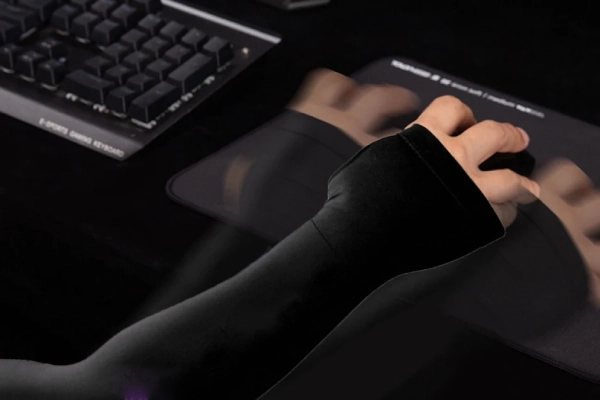
Keep the sleeve away from the palm pivot zone
If fabric shifts into the palm/heel-of-hand area, mouse control can feel different immediately. For most MOBA users, sleeve design should:
- end before it changes palm contact,
- avoid bulk at the wrist crease,
- avoid structures that constrain hand position unless specifically preferred.
Treat sleeves as comfort-first in MOBA
MOBA users most commonly benefit when the sleeve solves a comfort issue:
- desk edge rubbing the forearm,
- skin sticking when sweaty,
- rough pad/desk textures irritating skin during long sessions.
If someone is trying to replace a sleeve with clothing, the key problem is that cuffs, wrinkles, and fabric thickness create random friction changes—this is why Gaming Sleeve vs Long-Sleeve Shirt: Which Gives More Consistent Aim? is worth reading before switching.
Arm aim vs wrist aim: ergonomics (no medical claims)
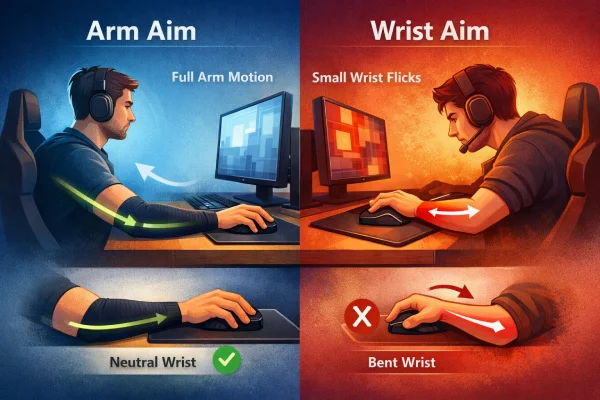
Ergonomics guidance commonly emphasizes a neutral wrist position and using larger arm motion rather than relying only on wrist flicking for extended mouse use. This is not a health claim—just a practical principle for long sessions: minimize extreme wrist angles and reduce unnecessary tension.
How to choose an arm sleeve for FPS vs MOBA
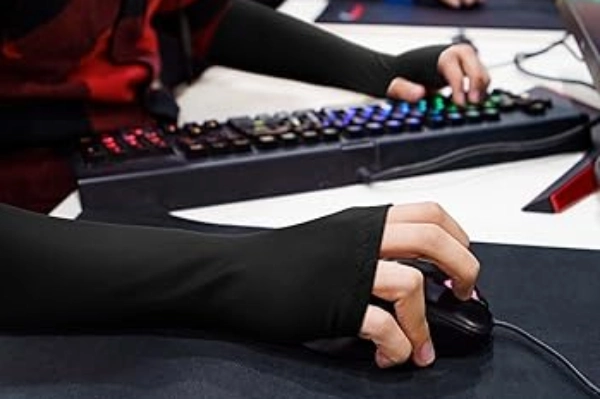
If you mainly play FPS
Choose a sleeve that:
- covers the primary forearm contact zone,
- uses low-profile construction in the glide area,
- keeps cuff edges off the pad contact zone,
- remains stable in sweaty conditions.
For a clean fit baseline, use the same sizing logic you’d apply to sports sleeves—How to Wear Arm Sleeves & Measure for the Right Fit keeps it simple and repeatable.
If your sleeve keeps creeping down mid-match, it’s usually taper mismatch or friction drop; the common causes and fixes are laid out in Why Do Arm Sleeves Slide Down? Causes & Fixes.
If you mainly play MOBA
Choose a sleeve that:
- keeps palm and grip feel unchanged,
- avoids tightness at the wrist crease,
- solves a clear comfort issue (rub/stick/sweat), otherwise it may be unnecessary.
If you’re unsure whether “snug” is already too much pressure, use this quick comfort check: How Tight Should an Arm Sleeve Be? A Simple Fit Test.
Materials & build (durability and feel, not medical promises)
If you’re comparing options for long-term smoothness, recovery, and pilling control, the material system matters more than marketing claims; the practical differences are explained in Arm Sleeve Materials Explained: Nylon, Spandex, Copper.
Common mistakes that break consistency
- Cuff edge on the mousepad
Creates a friction “step.” Move the cuff away from the glide zone. - Seam line directly under the forearm contact band
Even small seam height can create a catch point during fast reversals. - Using a sleeve to compensate for insufficient desk/pad space
If the setup doesn’t allow your normal travel distance, glide won’t feel consistent.
FAQ
Is arm aim always better for FPS?
Not always. Many FPS players use a hybrid: bigger arm/forearm motion for large turns, wrist/fingers for micro-corrections. The best method is the one that stays consistent across sessions and doesn’t force awkward desk or elbow positions.
Do MOBA players need a gaming arm sleeve?
Usually it’s optional. MOBA movement tends to be more concentrated, so glide consistency matters less than stable grip and pivot control. A sleeve is most helpful for comfort issues like rubbing, sweat stickiness, or rough desk/pad textures.
How can I tell if I’m “low sens” enough to benefit from a sleeve?
If your game uses camera rotation, check cm/360: higher cm/360 generally means more physical travel. More travel increases forearm contact time and makes friction changes more noticeable, especially once sweat and warmth change the contact surface.
Why does aim feel different after I start sweating?
Sweat changes surface friction and can create grabby spots between skin/fabric and the desk or mousepad. A sleeve can improve consistency by standardizing the contact surface, but results depend on pad material, posture, and seam/cuff placement.
OEM/ODM & custom sourcing
If you’re sourcing for a brand, team, or merch program, start from Custom Arm Sleeve to discuss logo, MOQ, and customization options. For a complete overview of workflow, QC, and production capabilities, see Complete OEM/ODM Sports Support Manufacture Guide.