When you are choosing knee sleeves for yourself or for your customers, one question appears very quickly: what mm knee sleeve should I get? Most performance sleeves come in 3mm, 5mm or 7mm, and some brands also offer thicker 7mm+ or 9mm versions. That single number changes how the sleeve feels on the leg, how much support it gives, and how realistic it is for different sports, training styles and work environments.
This guide looks at thickness from a biomechanics and real‑world use perspective. You will see what each thickness actually does, how it affects support and mobility, and how to match 3mm, 5mm and 7mm sleeves with different sports, body types and training levels.
How Knee Sleeve Thickness Affects Support and Movement
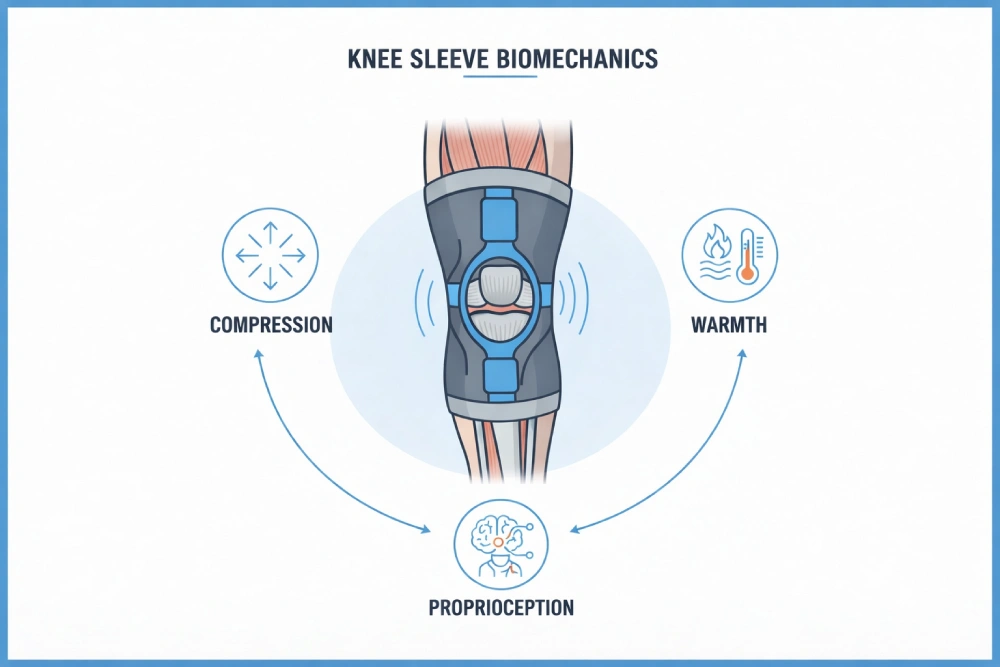
All neoprene knee sleeves work through the same three basic mechanisms. Thickness decides how strong each of these effects becomes, as shown in our custom neoprene knee sleeve collection with different thickness options.
A knee sleeve mainly influences:
- Gentle squeeze around the joint to support the soft tissues and help manage mild swelling
- Warmth around the knee so the joint and surrounding muscles stay at a stable working temperature
- Better joint awareness – the snug fit helps you feel exactly where your knee is and how it is moving
Thicker neoprene produces stronger compression, more heat retention and more powerful sensory feedback. Thinner neoprene keeps the knee light and free but offers less mechanical assistance. in” feeling. Thinner neoprene keeps the knee feeling lighter and freer, with less mechanical help from the sleeve. When you choose thickness, you are making a simple trade:
How much extra support do you want, and how much freedom are you prepared to give up, for your specific activity?
Quick Thickness Overview: 3mm, 5mm, 7mm and 7mm+
Before looking at each thickness in detail, it helps to see the options side by side. The table below summarises the main roles of each common thickness.
| Thickness | Main Role | Support Level | Mobility | Typical Use |
|---|---|---|---|---|
| 3mm | Light support, endurance & daily wear | Low | High | Running, field sports, long sessions |
| 5mm | All-round training & functional fitness | Medium | Medium | CrossFit, mixed training, general strength work |
| 7mm | High stability and rebound for heavy loads | High | Lower | Powerlifting, heavy squats and pulls |
| 7mm+ | Extreme support outside most rule sets | Very high | Low | Strongman, non-regulated heavy lifting only |
The rest of this article explains what these labels mean in practice and how to choose the thickness that matches your situation.
3mm Knee Sleeves – High Mobility and Long Wear

What 3mm Sleeves Actually Do
A 3mm knee sleeve is the thinnest standard neoprene option. It adds a soft hug around the joint and a bit of warmth without trying to change how the knee wants to move. Good 3mm designs use shaped panels so the sleeve follows the natural line of the leg. When the user runs, cuts, jumps or squats, the sleeve moves with the joint instead of fighting against it.
On the knee, a 3mm sleeve makes the joint feel warmer and more “present”, but bending and straightening stay very close to normal. Many athletes describe this as “minimal interference”: the sleeve is there, and you feel a touch more secure, but it never dominates the movement.
When 3mm Makes Sense
Because it is light and flexible, 3mm shines in situations where variety and duration matter more than maximum support. It fits naturally into:
- Long-distance running and trail running
- Team and field sports with constant changes of speed and direction
- Long conditioning blocks and circuit training
- Work shifts that involve hours of standing or walking
- Easy training or recovery days where a bit of warmth and confidence is enough
In these settings, the key is that people can keep the sleeves on for hours without feeling squeezed or overheated. The priority is comfort and freedom, not extra kilos on a heavy squat.
Where 3mm Falls Short
For serious strength work, 3mm is not designed to be the main tool. The thin neoprene does not store much spring, so there is almost no “bounce” out of the bottom of a heavy squat. The compression is also mild, which means less help with joint stability under very high loads.
That does not make 3mm a bad product. It simply puts the value in the right place: comfort, warmth and basic joint awareness. Lifters who focus on heavy squats, deadlifts or strongman events usually treat 3mm as a secondary sleeve for lighter days, cardio or daily support, not as their go-to for max strength.
5mm Knee Sleeves – The All‑Round Training Choice

How 5mm Balances Support and Flexibility
The 5mm knee sleeve is the most common choice for general training. It sits in the middle between “barely there” and “competition stiff”. Compared with 3mm, it gives noticeably stronger squeeze around the joint and more warmth, but it still lets the user move through a wide range of positions.
During squats, lunges and jumps, 5mm sleeves make the knee feel more stable without turning every rep into a fight with the neoprene. Users feel that the sleeve is helping, yet they can still run, change direction and drop into deep positions in the same session.
Best Uses for 5mm Sleeves
Because of this balance, 5mm sleeves work well wherever training is varied but demanding. They are a natural match for:
- CrossFit and functional fitness sessions
- High‑intensity interval training (HIIT)
- Gym‑based conditioning with lots of squats, jumps and lunges
- General strength training and bodybuilding workouts
- Olympic weightlifting at beginner to intermediate levels
In these environments, customers move between barbells, bodyweight work and conditioning in one workout. A 5mm sleeve is comfortable enough to keep on from warm-up to cool-down and strong enough to support the knees when the session gets heavy or high-rep.
Limits of 5mm for Heavy Strength Athletes
For lifters who later move into max‑strength and competition lifting, 5mm often becomes a transition thickness. It covers early and mid‑career loads very well, but as squat and deadlift numbers climb, many athletes look for more rebound and a firmer feel at the bottom of the lift.
At that point, 5mm sleeves are usually kept for lighter technique days, while 7mm sleeves take over on heavy barbell cycles and meet preparation. If your long-term plan or your target customer base leans toward powerlifting or very heavy squatting, it is useful to position 5mm as the daily workhorse and 7mm as the specialist upgrade.
7mm Knee Sleeves – Maximum Stability and Rebound

The Rebound Effect in Squats and Heavy Lifts
A 7mm knee sleeve uses the maximum thickness allowed by many powerlifting federations. The neoprene is thicker and denser than in 5mm models, and the sleeve often extends further up the thigh and down the calf. This combination creates strong compression and a very secure feel around the joint.
The key performance feature of 7mm sleeves is their rebound effect. When you descend into a squat, the sleeve stretches and stores elastic energy in the neoprene. As you rise, the material returns towards its original shape and releases part of that energy. The assist is small compared with your own force, but in heavy sets it can make the sticking point feel less abrupt and help you stay tighter in the bottom position.
Who Should Choose 7mm
Seven‑millimetre sleeves are aimed at athletes who spend a lot of time under heavy loads. They are especially common in:
- Powerlifting training and competition
- Heavy squat and deadlift cycles for strength‑focused athletes
- Olympic weightlifting strength phases and squat blocks
- Advanced bodybuilding programmes that include very heavy leg work
For these lifters, a stronger sleeve is not just about comfort. It is part of a broader strategy to manage joint stress, maintain consistent positions and get the most out of each heavy repetition.
Practical Drawbacks You Need to Know
The same features that make 7mm sleeves attractive for heavy lifting also bring some disadvantages.
They trap more heat and can feel oppressive if worn for an entire mixed session. Tight performance fits can be difficult to put on and remove, which is why many lifters only wear them for work sets and roll them down or take them off between efforts. Range of motion for running, deep lunges or fast changes of direction may also feel restricted.
For these reasons, 7mm sleeves are usually described as a specialist tool. They are excellent at supporting heavy strength work, but they are rarely the best choice for endurance, long conditioning blocks or casual daily wear.
Beyond 7mm: Competition Rules and 9mm Sleeves

In regulated strength sports, equipment rules limit how far sleeves can go. Many federations cap knee sleeve thickness at 7mm and length at about 30 cm. Within those limits, brands compete through neoprene density, length and cut rather than raw thickness.
Outside of those rule sets, especially in strongman and some non‑standard competitions, extra‑thick sleeves such as 9mm models are sometimes used. These sleeves rely on very dense neoprene and aggressive patterns to create powerful compression and a strong extension bias. They are designed for elite athletes handling very large loads and are not intended for beginners or general gym users.
For most people and most product lines, 9mm sleeves sit at the edge of the market: useful in a few special cases, but not a core thickness.
Same Thickness, Different Feel: Density, Length and Pattern

Thickness is only one part of how a sleeve feels. Two 7mm sleeves from different brands can behave very differently.
Three design factors matter a lot:
- Neoprene density and purity – denser foam feels firmer and creates stronger compression and rebound
- Length – a longer sleeve covers more of the quadriceps and hamstrings, spreading pressure and adding stability
- Cut and panel shape – straighter cuts can feel more aggressive, while anatomical patterns may feel smoother at the same tightness
For athletes, this means that trying models or checking detailed specifications is just as important as picking a number. For brands and buyers, it is a simple way to build multiple products from one thickness by adjusting density, length and pattern for different target users.
How to Choose Thickness by Sport and Training Style

The most reliable way to answer “what mm knee sleeve should I get” is to start from how the knees are used in a normal week.
Strength Sports and Max‑Load Training
In powerlifting and other max‑strength sports, the main goal is to move heavy weights with control. Squats and pulls are usually central, and the athlete often works close to their limits.
In this context, 7mm sleeves are usually the primary choice. They provide the strongest compression and rebound, and they meet the equipment rules of most federations. Some lifters also keep 5mm sleeves for lighter technique days when they still want support but do not need the full strength of 7mm neoprene.
Mixed Training: CrossFit and Functional Fitness
Mixed training blends barbell work, bodyweight skills and conditioning into a single session. Knees move through deep flexion, repeated jumps and often running or rowing.
Here, 5mm sleeves tend to be the most practical option. They are strong enough to support high‑rep squats, lunges and Olympic lifts, while still flexible enough for burpees, sprints and box jumps. Using 7mm sleeves in this style of training is possible, but many athletes find them too hot and restrictive for longer workouts.
Endurance and Field Sports
Endurance runners, trail runners and field sport athletes ask their knees to absorb many thousands of lighter impacts instead of a few very heavy squats.
For this pattern, 3mm sleeves or lighter knitted supports make more sense. They keep the joint warm, reduce irritation from clothing and offer a touch of extra awareness without adding noticeable resistance or weight.
Work and Daily Support
People who stand or walk for long periods in their job often look for sleeves that stay comfortable over a full shift. In these cases, 3mm sleeves are often the first option, because they can be worn for many hours without digging in. For shorter, more intense periods of activity, such as warehouse work that includes lifting, a 5mm sleeve can be a useful upgrade.
Personal Factors: Body Type, Knee History and Experience

Thickness choice is also influenced by individual characteristics.
Body Size and Compression Tolerance
Lifters with larger thighs and calves generally tolerate and benefit from higher compression. On a big leg, a 7mm sleeve may feel firmly supportive but still manageable. On a much smaller leg, the same model and size can feel overwhelming, especially if sized down for performance.
Joint History and Sensitivity
Knees with a history of irritation, mild injury or early arthritis often respond well to extra warmth and moderate compression. For these users, 5mm sleeves are a sensible starting point. They provide noticeable support without the intensity of very tight 7mm sleeves.
Beginner vs Advanced Athlete
Beginners usually gain more from technique improvements and smart loading than from maximal sleeve performance. For them, a 5mm sleeve can provide reassurance and mild support while still allowing them to feel how the joint should move.
More advanced lifters, especially those already squatting and pulling heavy weights, can plan for 7mm sleeves as part of their long‑term strength equipment. In many programmes, 5mm sleeves remain useful for lighter days even after 7mm sleeves are introduced.
Fit and Tightness Strategy for Each Thickness

Thickness tells you what a sleeve can do. Fit decides how much of that potential you actually use.
Comfort Fit vs Performance Fit
Most sizing charts are built around a comfort fit: the sleeve is snug but still practical to wear for a full session. This approach works well for 3mm and 5mm sleeves used in mixed training, endurance, work or daily support.
A performance fit means deliberately choosing a smaller size to increase compression. This is more common with 7mm sleeves, especially among competitive lifters who want the strongest rebound and the firmest feel in heavy squats.
When Sizing Down Makes Sense
Sizing down may be worth considering if:
- Your main focus is max‑strength training or competition
- You only plan to wear the sleeves for short, heavy sets
- You can still put them on and remove them without excessive struggle
For general fitness, mixed training and long sessions, staying close to the recommended size is usually a better strategy.
Warning Signs Your Sleeves Are Too Tight
Regardless of thickness, certain signals show that compression has gone too far:
- Numbness, tingling or colour change in the lower leg or foot
- Loss of normal squat depth that returns when the sleeves are removed
- Sharp discomfort around the edges of the sleeve
- Difficulty wearing the sleeves for more than a few sets
If any of these appear, it is worth reassessing the thickness, size or how long you keep the sleeves on.
Thickness vs Function: A Simple Summary
The following table brings the main differences between 3mm, 5mm and 7mm sleeves together.
| Feature | 3mm (Flexible) | 5mm (All-Round) | 7mm (Strength-Focused) |
|---|---|---|---|
| Typical use | Endurance, agility, daily wear | Functional fitness, general strength training | Powerlifting, heavy squats and pulls |
| Compression strength | Mild | Clear, moderate | Strong |
| Proprioceptive input | Light increase | Noticeable improvement | High-fidelity feedback |
| Rebound in squats | Minimal | Mild boost | Significant when loaded and fitted tightly |
| Impact on mobility | Little to none | Moderate, still suitable for mixed sessions | Clear restriction in very deep or fast flexion |
| Long-session comfort | Best | Good | Lower; often used only for work sets |
This comparison can serve as a quick reference when matching sleeves to athletes or to target customers.
Care, Durability and Real‑World Use
Whichever thickness you choose, construction quality and care have a strong effect on how long knee sleeves keep their compression and shape.
Durability depends on:
- The quality and density of the neoprene foam
- The strength of the outer fabric and inner lining
- The stitching pattern and reinforcement at stress points
Thicker sleeves, especially 7mm models worn very tightly, place more stress on seams and fabric. For heavy strength users and bulk buyers, paying attention to these construction details helps avoid premature failure.
Care is simple to explain to customers. For best results, wash sleeves by hand in lukewarm water with neutral, mild detergent. If by washing machine, place the sleeves in a laundry bag and select a gentle or delicate cycle. After washing, rinse thoroughly, press out excess water without wringing and let the sleeves air-dry completely. Avoid tumble drying as much as possible, because heat and mechanical stress will shorten the life of the neoprene.
Do You Need More Than One Thickness?
Not every athlete needs a full collection of sleeves. Many people can train effectively with a single, well‑chosen thickness.
If endurance, field sports or long hours on your feet are your main activities, 3mm sleeves are usually enough. If your weeks revolve around gym‑based training with a mix of strength work and conditioning, 5mm sleeves cover most needs.
Athletes who take strength development further often benefit from having two thicknesses:
- 5mm for moderate training days and mixed sessions
- 7mm for heavy strength cycles and testing days
For brands and wholesale buyers, this pattern is useful. A clear 3mm–5mm–7mm ladder, combined with different materials and cuts, can serve different segments without creating unnecessary complexity in the product line.
Thickness‑Focused FAQ
Q1: Is 5mm or 7mm better for squats?
For most lifters, 5mm is better for regular squat training and mixed sessions. It gives clear support without locking your knees and is easier to wear for longer workouts. If your main goal is maximal squat strength or powerlifting, 7mm usually offers stronger rebound and joint stability.
Q2: Should I size up or down in knee sleeves?
Most people should start with the size recommended by the brand’s chart. Sizing down is mainly for experienced strength athletes who use 7mm sleeves only for heavy sets and accept a harder, tighter fit. If you wear sleeves for full sessions or daily use, avoid aggressive downsizing.
Q3: Are thicker knee sleeves always better?
Thicker sleeves are not automatically better. Seven-millimetre models give more compression and rebound, but they also limit mobility, trap more heat and are harder to wear for long sessions. The “best” thickness depends on your sport, training volume and comfort, not just on getting the stiffest sleeve.
Q4: Are 3mm knee sleeves worth it for lifting?
For light to moderate lifting, 3mm sleeves can be helpful by keeping the joint warm and providing gentle feedback without restricting motion. For serious strength work, their mechanical support and rebound are limited. If heavy barbell training is a priority, 5mm or 7mm usually offers more value.
Q5: Do knee sleeves help prevent knee injuries?
Knee sleeves can support injury prevention indirectly by improving blood flow, reducing mild swelling and increasing joint awareness, which makes it easier to control positions under load. They do not protect against reckless programming or poor technique. Think of them as one tool alongside smart programming and good movement.
Conclusion: Turn “What mm Knee Sleeve Should I Get?” Into a Clear Decision

Choosing the right knee sleeve thickness is about matching support to the work your knees actually do. Thinner 3mm sleeves suit endurance, agility and long wear. Five‑millimetre sleeves are the all‑round option for mixed training and general strength work. Seven‑millimetre sleeves are specialist tools for heavy squats, heavy pulls and strength sports where maximum stability and rebound are genuinely useful.
When you look at thickness through that lens, the question “what mm knee sleeve should I get” becomes much easier to answer—for individual athletes and for brands planning a clear, purposeful product range.