Why Labels Alone Mislead Knee Support Buying Decisions

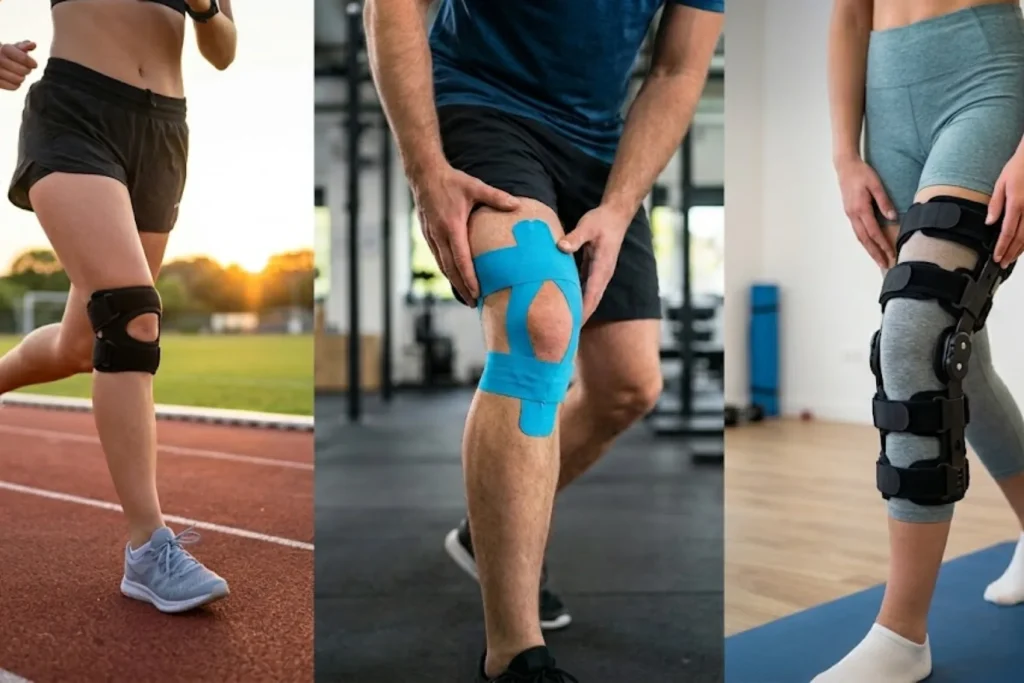
The term “Knee Support” is a high-traffic umbrella in the protective gear market, but it lacks technical precision. In retail environments, products ranging from simple elastic tubes to complex mechanical hinges are often grouped under this single label. A soft sleeve is called a brace. A wrap with a strap is called a support in one store and a brace in another.
To build a high-performing line, you have to look past the labels. You need to categorize by what the product actually does to the joint.
The “Job to be Done” Framework
Instead of asking “What is this called?”, ask “What job is this knee support doing for the user?” Almost every product in your catalog should fall into one of these three functional “jobs”:
- The Sleeve (Compression):
The job is to provide warmth and help the user feel more “solid” and in control of their movement.
Choose sleeves when your customers are healthy or mildly symptomatic users who want confidence, warmth, and faster recovery for training and daily sports. - The Brace (Stabilization):
The job is to physically stop the knee from moving the wrong way.
Choose functional braces when they report instability, are returning to sport after injury, or need extra lateral support without moving into full medical devices. - The Pad (Protection):
The job is to absorb impact from the outside.
Choose pads when their sport or work involves frequent contact with the floor or ground (diving, sliding, kneeling) and impact protection matters more than joint control.
Knee Sleeves: The Performance Multiplier
Knee sleeves are the simplest form of knee gear. They are elastic, pull-on tubes made from thin neoprene or modern knitted fabrics.
But don’t let the simple look of a sleeve fool you. In the fitness and cross-training markets, sleeves are your #1 volume drivers because they solve a problem that heavy braces can’t: they protect without sacrificing an ounce of speed or range of motion.
What They Really Do
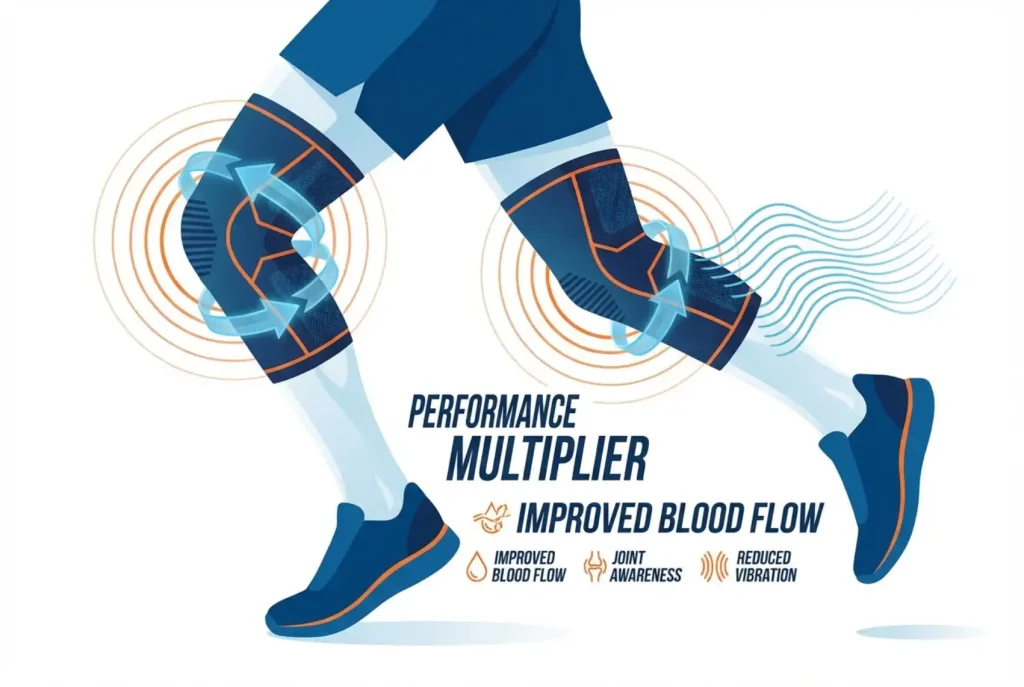
While it doesn’t use metal to lock the joint, the firm supportive compression acts like a high-speed data cable between the knee and the brain. It provides constant sensory feedback (joint awareness), allowing an athlete to self-correct their form in milliseconds—preventing bad movements before they lead to a twist.
Also, it’s about circulation and recovery. The compression increases blood flow and oxygen to the joint while keeping the “joint oil” (synovial fluid) warm and thin. This means less stiffness, reduced swelling after a workout, and a much faster recovery time. Finally, it reduces muscle oscillation—the micro-vibrations that happen every time your foot hits the ground. By dampening these vibrations, the sleeve helps muscles work more efficiently and delays fatigue.
In short: a brace is for when you’re broken; a sleeve is for when you want to be unbreakable and recover faster.
Explore performance knee sleeve collections or View recovery-focused compression sleeve options as real-world examples.
Knee Braces: Dynamic Support & Structural Stabilization
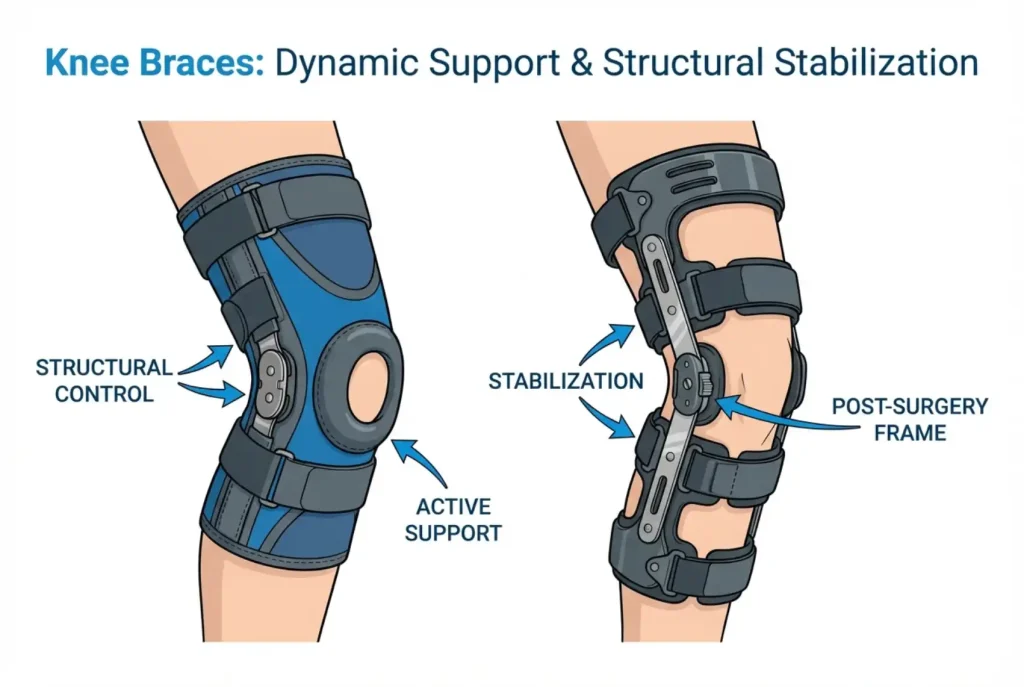
It is defined by the use of rigid or semi-rigid hardware—like hinges and reinforced stays—to control how the knee moves physically.
While sleeves and wraps rely on fabric tension to support the knee, a brace uses structural hardware to block dangerous movements. It is a piece of safety engineering designed to ensure the joint cannot buckle, snap backward (hyperextend), or twist into angles that cause ligament tears.
The Two Practical Forms:
- Hybrid Performance Braces (For Active Sports):
These are built on a textile base (3D knit or neoprene) but “upgraded” with hinged side-stays and silicone rings. You stock these for athletes who need a mechanical safety net while running, jumping, or pivoting. It’s the “best of both worlds”: the comfort of a sleeve with the protection of a brace. - Rigid Framework Braces (For Post-Surgery & Medical):
Often called “exoskeletons,” these use high-strength aluminum or carbon fiber frames. You can stock these for clinical recovery or patients who have just come out of surgery. Their job is to strictly lock or limit the leg’s movement to allow ligaments to heal without any risk of shifting.
Please note that we, ZZUPPORT, manufacturing focuses on the sports and daily-support segment (sleeves, functional braces, and pads), which does not include post-surgical rigid frameworks.
You can browse our functional knee brace designs and compare lateral-support knee brace configurations.
Knee Pads – Impact and Pressure Protection from the Outside
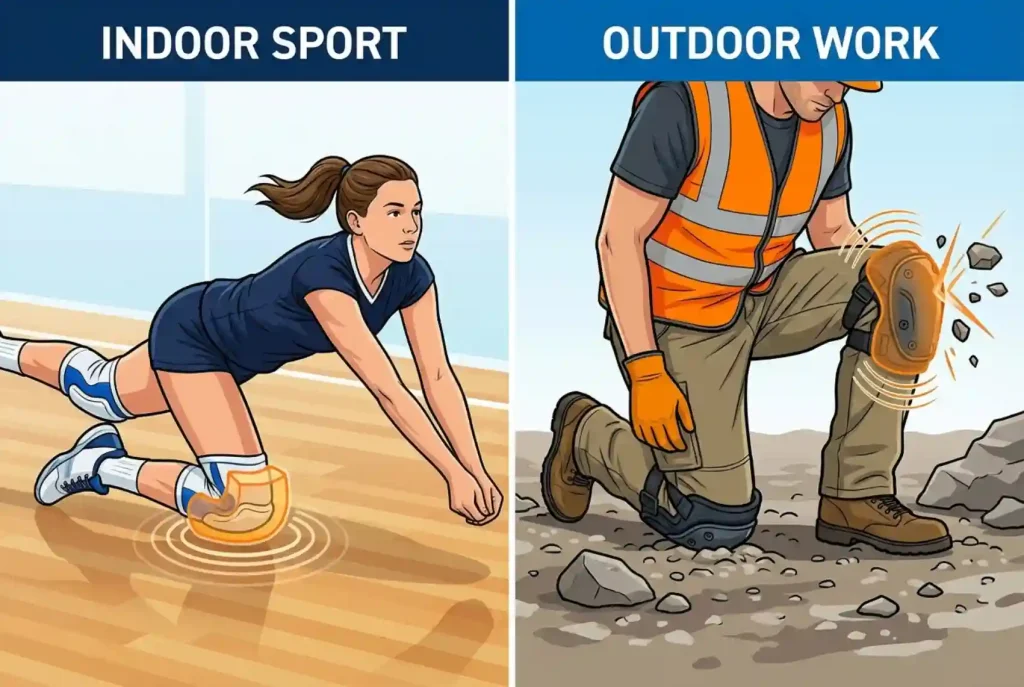
Knee pads play a completely different role from sleeves and braces. They are not “more supportive sleeves” – they are cushions. They don’t try to “control” the joint at all – their job is simple and brutal: take the hits so the knee doesn’t have to.
Most sports knee pads use a soft fabric shell with foam padding, while work and tactical knee pads usually add a hard plastic cap on the front for extra protection on rough surfaces.
If your portfolio covers youth academies, indoor court sports, or workwear channels, knee pads can act as an “entry product” with clear visual value and straightforward sizing, making them easy to introduce as a first purchase. Review impact-protection knee pad lines, or see workwear and tactical knee pad options.
Quick Overview: Matching Function to Market Demand
| Product Category | Primary Function | Key Sourcing Feature | User Experience |
| Knee Sleeves | Confidence & Blood Flow | High-stretch 3D Knit / Neoprene | “I feel faster and more stable.” |
| Knee Braces | Joint Stabilization | Metal Hinges / Side Stays | “I feel safe and locked in.” |
| Knee Pads | Impact Shielding | EVA Foam / Gel / Hard Shells | “I don’t feel the hard floor.” |
How to Source Sleeves, Braces, and Pads by Use Case
In the global sports gear trade, understanding the end-user’s intent is crucial for inventory turnover. Based on our years of manufacturing experience, here is the market breakdown for these three categories:
Knee Sleeves: Performance & Recovery
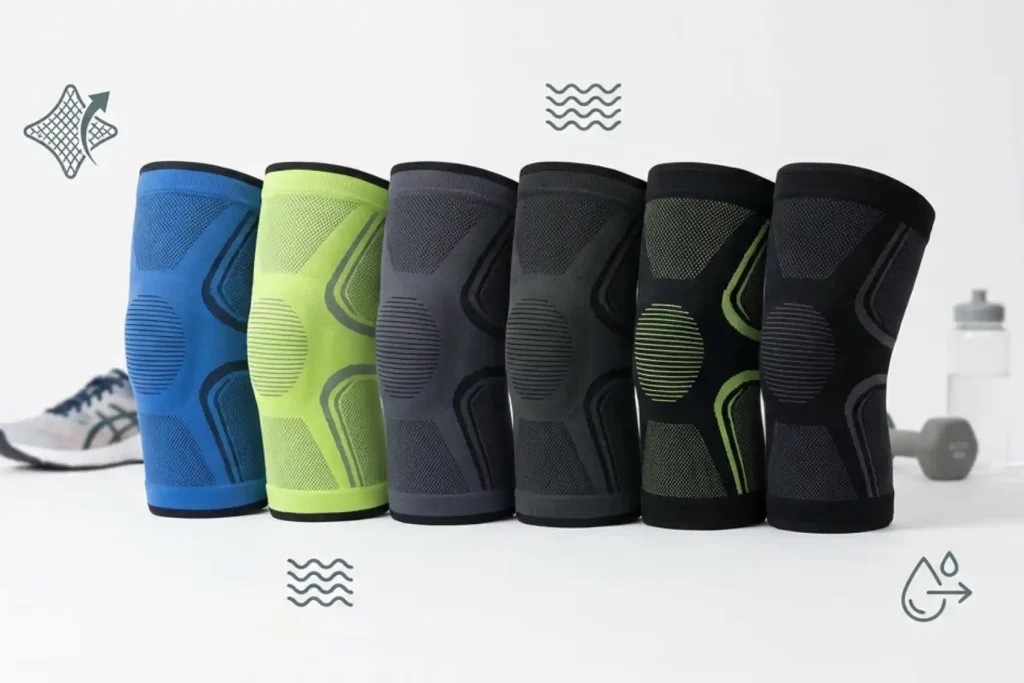
Target Scenarios: High-frequency, repetitive activities such as long-distance running, gym training, CrossFit, and daily fitness.
Market Dynamics: These are high-turnover “consumable” supports. Since users wear and wash them daily, the typical replacement cycle is 3–6 months.
Mass-market consumers prioritize breathability and anti-slip performance. For OEM orders, we recommend focusing on 3D circular knitting technology or lightweight SBR, offered in various colorways to align with seasonal activewear trends.
Functional/Reinforced Braces: Stability & Lateral Support
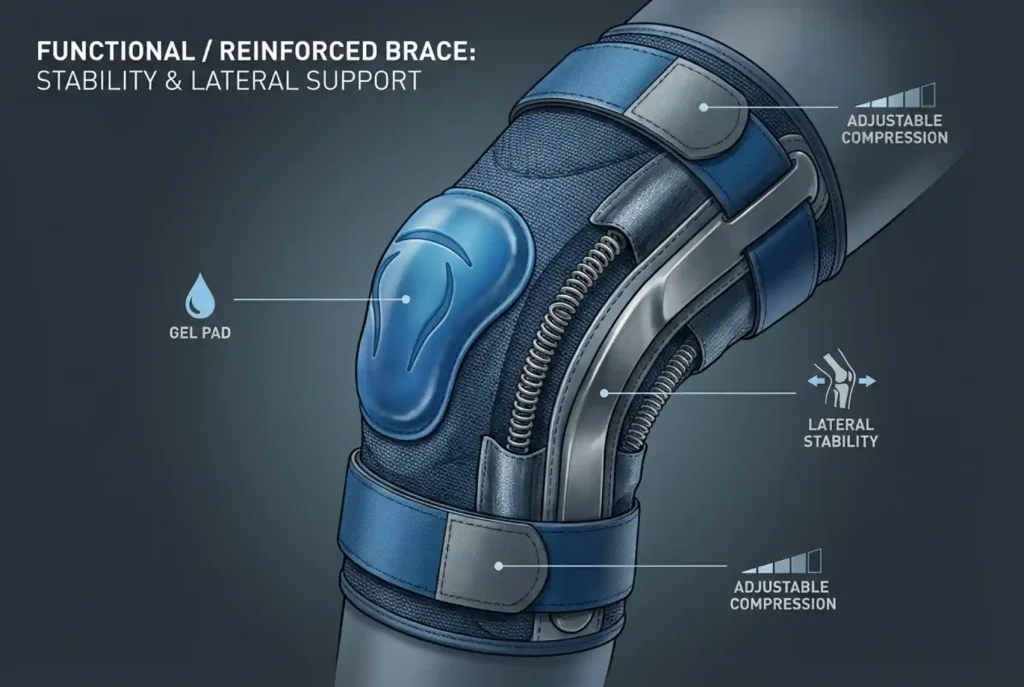
Target Scenarios: Sports requiring lateral agility (e.g., tennis, soccer, skiing) and long-term support for aging joints or mild instability.
Product Logic: These are “hybrid” upgrades of the standard sleeve. Rather than using rigid medical skeletons, they utilize a textile base reinforced with functional components to provide mechanical stability without sacrificing comfort.
Manufacturing Key Components:
- Side Stabilizers: Embedded spiral stays or flexible spring bars that distribute lateral pressure.
- Patella Gel Pads: Anatomically shaped silicone inserts to track the kneecap and absorb impact.
- Adjustable Strap Systems: High-tension Velcro straps allowing users to customize compression levels.
This is a high-margin category. It offers professional-grade protection without the strict regulatory hurdles of medical devices. Buyers should focus on the rebound resilience of the stabilizers and the durability of the strap attachments.
Knee Pads: Impact Defense
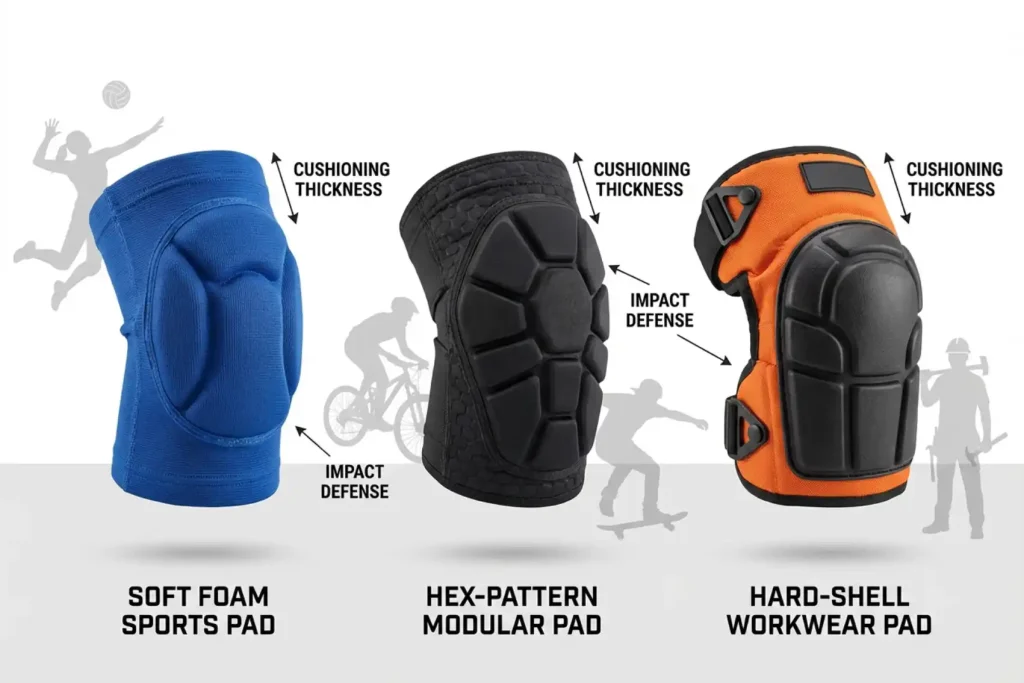
Target Scenarios: High-impact activities involving ground contact, such as volleyball, mountain biking (MTB), skateboarding, and professional workwear (tactical/construction).
Market Dynamics: Functional-driven demand. Youth sports academies are major buyers, as pads are essential “entry-level” safety gear for these activities.
Buyer Insight: Cushioning performance is the core KPI. We recommend high-density EVA or modular Hex-pad designs to ensure maximum shock absorption while maintaining a full range of motion.
Quick Overview of Knee Sleeve vs Brace vs Pads
| – | Knee Sleeves | Knee Braces | Knee Pads |
|---|---|---|---|
| Core purpose | Keep the knee active & responsive | Control / stabilize joint movement | Cushion the knee from impact & pressure |
| What it does | Light compression, warmth, better feel | Blocks or limits risky angles (twist, buckle) | Absorbs shocks when diving, falling, kneeling |
| Movement feel | Almost no restriction, “wear and forget” | Clearly more held, some bulk and restriction | Free movement; protection only on contact |
| Main scenarios | Fitness, running, team sports, daily use | Injury risk, return-to-sport, higher support | Volleyball, basketball, wrestling, dance; construction, flooring, gardening, DIY |
Compliance You Can Trust, Consistency You Can Scale
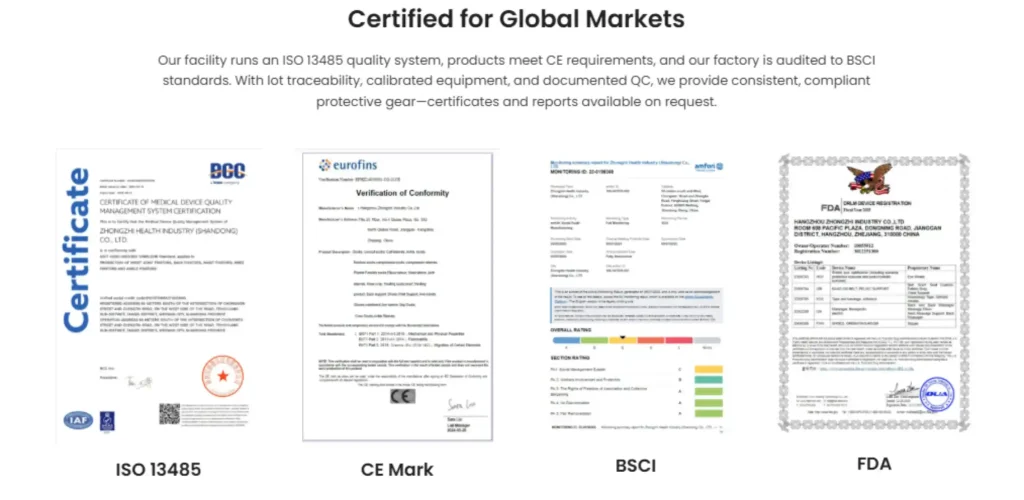
Certified, Market-Ready Materials
We source yarns, neoprene, and foams that meet major international safety standards such as REACH and OEKO-TEX. That means your knee supports are built on materials already aligned with key import rules, reducing compliance headaches and customs risk in your target markets.
Stable Specs, Batch After Batch
Every style is locked to a clear spec sheet, and we control core metrics like fabric GSM and compression level across production. This keeps each batch close to the original “golden sample,” so your customers get the same fit, feel, and performance from first order to repeat order.
For a detailed breakdown of our development workflow, sampling process, and production controls, you can refer to our OEM & ODM manufacturing guide.
FAQs
Is a knee sleeve or a knee brace better for knee pain?
It depends on the type of pain. Sleeves are best for mild discomfort, swelling, or a feeling of “weakness” during activity because compression improves circulation and joint awareness. Braces add structural control and are more appropriate for instability, ligament injury, or post-surgery support under medical guidance.
Can I wear a knee sleeve all day?
Most healthy users can wear a correctly fitted sleeve during waking hours and training sessions. It should feel snug but not numb, tingly, or painfully tight. If you notice increased pain, swelling, or skin irritation, remove it and reassess fit—or advise users to speak with a medical professional.
Do knee sleeves or braces actually prevent injuries?
They reduce risk in specific situations but cannot guarantee injury prevention. Sleeves improve feedback and warmth, which may help athletes move more efficiently. Braces can limit dangerous ranges after injury. Neither replaces strength training, technique coaching, or rehab; that is where most long-term protection actually comes from.
Are knee sleeves good for squats and weightlifting?
Yes, for many lifters. Sleeves provide warmth, compression, and a more secure feel around the joint, which can make heavy sets more comfortable and consistent. They may slightly improve performance, but they do not fix poor technique or replace progressive strength training and proper load management.
Can a knee brace make my knee weaker over time?
Wearing a brace alone does not automatically weaken the knee, but relying on it instead of rebuilding strength and mobility can keep muscles under-trained. Best practice is to combine a brace with a rehab or conditioning program so support gradually becomes optional rather than permanent.
Conclusion: Building a Balanced Product Matrix
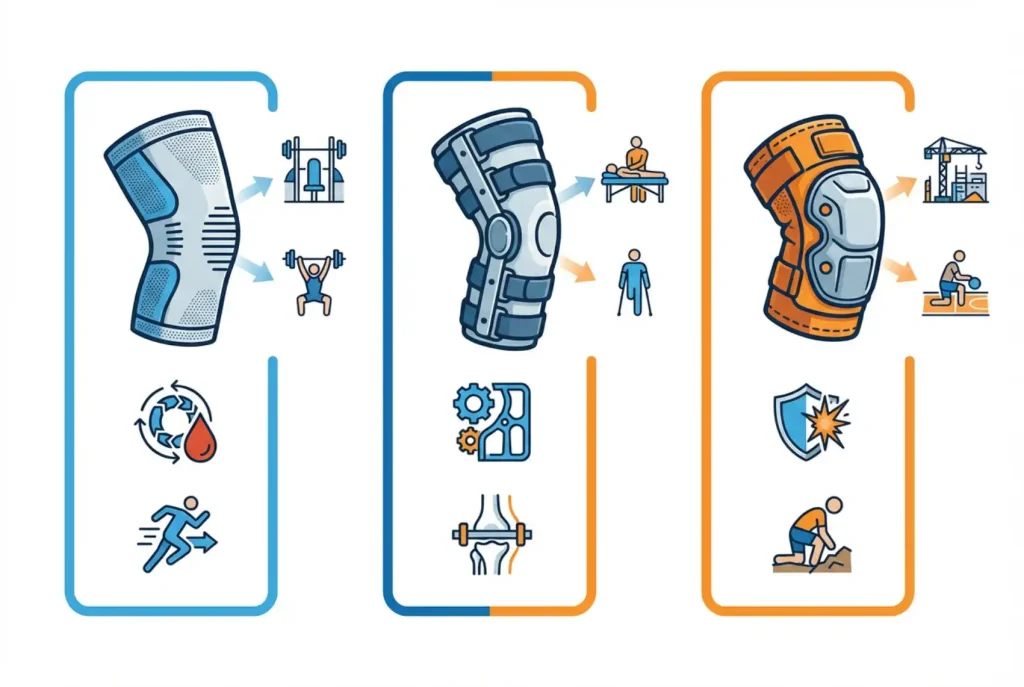
The distinction between knee sleeves, braces, and pads is not about which is “better,” but which functional job the gear is designed to perform.
For brands and buyers, a successful product line avoids the “one-size-fits-all” trap. Instead, it leverages a mix of these three categories to cover the full spectrum of user needs—from the gym floor to the post-injury recovery phase. By matching clear technical specifications with these specific use cases, brands can stand up to the demands of the global market.
Looking to refine your next Knee Support collection? Contact our team to discuss material specifications, custom BOMs, or to request our latest product catalog.