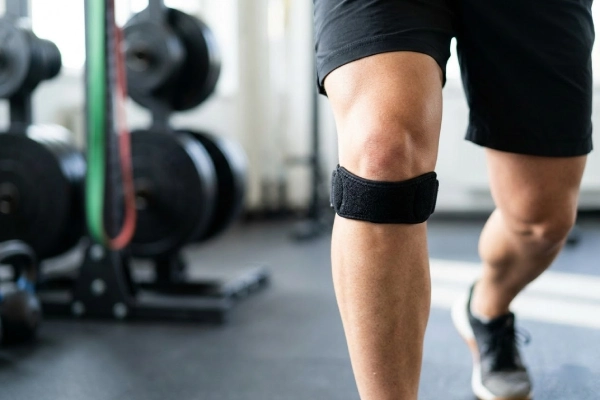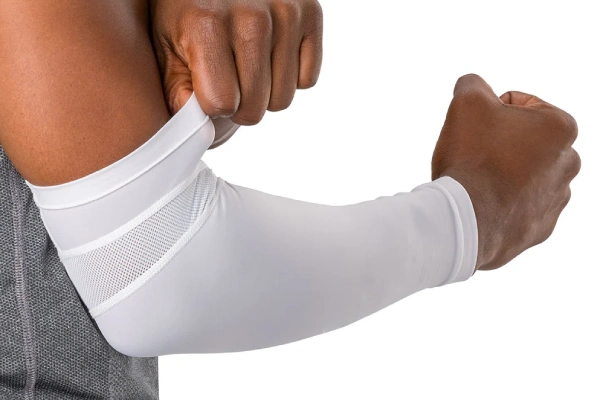
No — wearing a knee sleeve will not weaken your knee. A typical 5–7mm neoprene sleeve generates only a few Newtons of elastic restoring force, derived from a Young’s modulus in the 2–5 MPa range. Your quadriceps generate roughly 1,000 to 3,000 Newtons during a normal walking step, and several thousand more during a heavy squat. The sleeve contributes a fraction of one percent of the force picture during a step. There is simply nothing meaningful for the muscle to “offload” onto, and so no mechanism by which the muscle would adapt by producing less.
The atrophy concern that gets attached to knee sleeves is borrowed — accurately — from clinical research on rigid hinged braces, which are a different product entirely. Confusing the two is where almost all of this myth comes from.
The real risk with a sleeve isn’t muscle weakening. It’s using one to mask pain so you keep loading a knee that needs rest or assessment. That problem is about decision-making, not about the fabric. I’ve been making knee sleeves in Shandong since 2008. What follows is what the materials actually do, where the dependency concern is real, and where it is myth.
Where the “knee sleeves weaken your knees” worry comes from

This worry is reasonable. A lot of online advice mixes up two very different products, so the same warning ends up pasted onto both — and once you have seen the warning attached to “knee support” three or four times, the distinction stops registering.
Most of the muscle-atrophy concern that gets attached to knee sleeves originates in clinical research on rigid hinged braces — post-surgical knee braces, functional braces after ligament reconstruction, and unloader braces used for osteoarthritis. Those products carry meaningful joint load through metal or polymer frames. Long-term continuous use without a graded weaning protocol is a documented clinical concern in that category.
A knee sleeve is a different object. It is a passive compression garment — a tube of neoprene or stretch knit that warms the joint, applies mild even pressure, and gives the skin and superficial tissues a constant tactile signal. It does not transfer load through a frame, it does not stabilize the joint mechanically, and it does not replace the work of the quadriceps, hamstrings, or stabilizing ligaments.
The myth survives because both products are worn on the knee, both get called “knee support” in everyday language, and both look superficially similar in marketing photos. Once you separate them, the question almost answers itself. For a side-by-side breakdown of the product categories, see our comparison of knee strap vs. knee brace vs. knee sleeve.
What a knee sleeve can — and cannot — do mechanically
Here is the most useful thing I can tell you, and it’s the piece most articles on this topic skip.
A knee sleeve is made from one of two material families:
- Neoprene — closed-cell synthetic rubber, typically 3mm, 5mm, or 7mm thick
- Knit blends — nylon, polyester, and elastane (spandex) woven into a stretch tube
Both have a Young’s modulus in the range of roughly 2 to 5 MPa — well within the published range for polychloroprene elastomers, which sits between 1 and 10 MPa. For comparison, the Young’s modulus of human tendon is around 1,000 MPa — three orders of magnitude stiffer. Bone is about 17,000 MPa. The fabric on your knee is not in the same physical universe as the connective tissue underneath it.
When a typical 7mm neoprene sleeve is stretched over a flexed knee, the restoring force it generates is on the order of a few Newtons — small enough that it cannot meaningfully share load with the muscles or ligaments around the joint. It is not load-bearing in any functional sense. It cannot replace, supplement, or relieve what the muscles around the knee are doing during walking, running, or squatting.
What the sleeve does do well — warming the joint, applying mild graduated compression typically in the 15–25 mmHg range, and giving the joint’s mechanoreceptors a constant skin signal — does not require your muscles to do less work. It changes tissue environment and perception, not load distribution. The mechanisms behind each of these effects, and the modest evidence base behind each, are covered in our complete guide to what a knee sleeve actually does.
When dependency is actually a problem
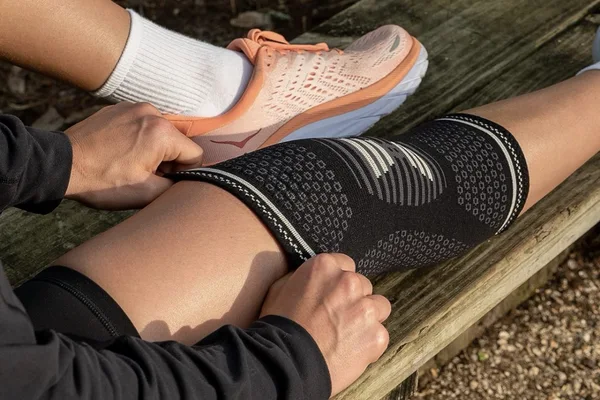
The honest answer here matters more than the reassuring one. A knee sleeve will not cause muscle atrophy on its own. But there are three situations where wearing one becomes a problem — and none of them are about the fabric weakening the knee.
1. Using a sleeve to mask real pain. Compression and warmth genuinely reduce the perception of pain. If you have an undiagnosed meniscus tear, patellar tendinopathy, or early osteoarthritis, a sleeve can make a damaged knee feel good enough to keep training on. The damage continues regardless of how comfortable you feel. This is the single most important warning on this topic, and it has nothing to do with atrophy — it is about losing the warning signal that tells you to stop.
2. Wearing a sleeve instead of doing the rehab work. After an injury, the path back to a strong knee is loaded progressive strengthening — usually some version of quadriceps activation, glute work, and eccentric loading prescribed by a physical therapist. A sleeve does not strengthen anything. If you wear one to feel stable and skip the rehab work, your knee will not get stronger. That is not the sleeve weakening anything; it is the missing rehab.
3. Psychological reliance. Some athletes feel uneasy training without their sleeve once they have gotten used to it. This is real but it is not physical weakening — the muscles are unchanged. The fix is straightforward: train without it on some sessions and let the unfamiliarity pass.
The two populations who ask this question have different real concerns. Healthy training athletes — gym, running, jumping sports — seldom face situations 1 or 2. The recovery population, anyone returning from a real injury, needs to take both seriously. For an injured knee, a sleeve is an adjunct to rehab, not a substitute for it.
What current research says
The clinical literature on knee sleeves is modest in size but consistent in direction. None of the well-designed studies show muscle atrophy from sleeve use. Several show measurable improvements in proprioception and reduced perceived instability.
- A randomized controlled trial published in JOSPT investigated exactly this question in patients with patellofemoral osteoarthritis and found that wearing a flexible knee support did not reduce maximum voluntary contraction or increase muscle inhibition of the quadriceps (Callaghan, Parkes & Felson, 2016). This is the single most relevant study on the muscle-weakening question.
- A study in Scandinavian Journal of Medicine & Science in Sports found that a neoprene knee sleeve actually compensated for the proprioceptive deficit caused by muscle fatigue, with no negative effect on the unfatigued knee (Van Tiggelen et al., 2008).
- A literature review in Physical Therapy in Sport surveyed the biomechanical and functional evidence and concluded that knee sleeves produce neutral-to-positive functional outcomes — improvements in proprioception for healthy knees, gait for osteoarthritic knees, and function for injured knees — with no findings of induced weakness (Bryk et al., 2017).
The picture across these sources matches what the material physics predicts: the sleeve is too compliant to do the muscle’s work, so the muscle keeps doing it.
How to use a sleeve so the question never becomes relevant
Two principles cover most cases.
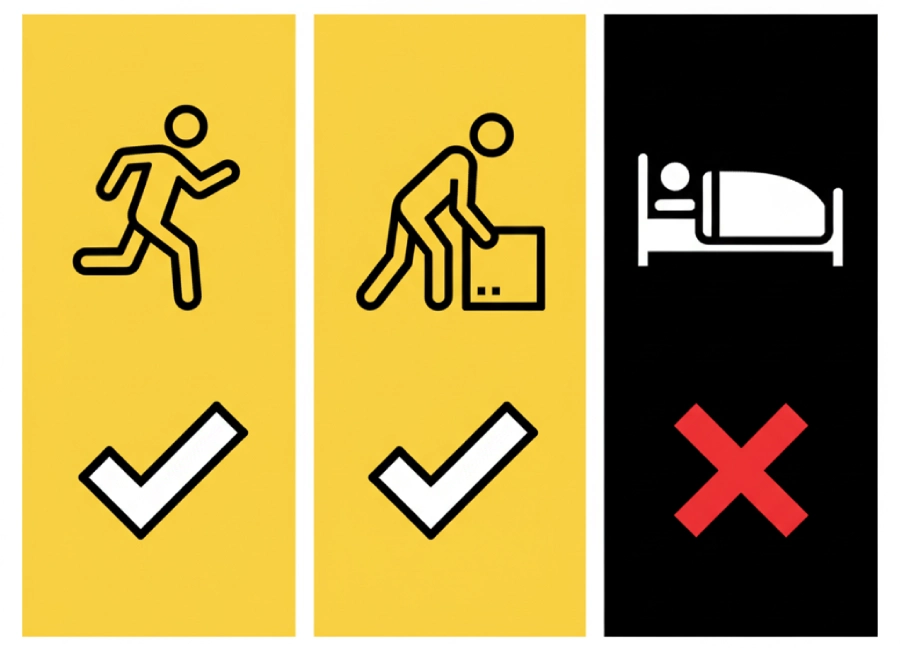
Wear it for the activity, not for the day. Most people get the full benefit from a sleeve during training, running, or hiking, then take it off afterward. There is no functional reason to wear one continuously, and continuous wear can cause skin irritation or disrupt circulation when the fit is too tight. Timing specifics — pre-workout warmth, post-workout swelling control, when to skip it — are covered in when to wear a knee compression sleeve.
Size for compression, not constriction. A sleeve that leaves a deep red ring or causes the calf to tingle is too tight. Tightness, not the sleeve itself, is what produces the only circulation-related issues we see in end-user feedback. Sizing detail is in our knee sleeve sizing guide.
If you are recovering from an injury, treat the sleeve as part of the rehab toolkit, not the whole of it. Strength work is what rebuilds the knee. The sleeve makes the work more comfortable.
Frequently asked questions
Will wearing a knee sleeve every day cause muscle atrophy?
No. Muscle atrophy requires either disuse — immobilization, bed rest, denervation — or significant load offloading. A knee sleeve does neither. It does not immobilize the joint, and the few Newtons of elastic restoring force it produces cannot carry meaningful load. The muscles keep working as normal.
Are knee sleeves bad for your knees long-term?
For a healthy person using a sleeve during activity, no — there is no published evidence of long-term harm. The two situations where long-term sleeve use becomes problematic are using one to mask an undiagnosed injury and wearing one tight enough to disrupt circulation. Neither is inherent to the product.
Can I sleep in a knee sleeve?
Generally not necessary, and not advisable for most people. Lying still for hours under constant compression can disrupt circulation in ways that walking around does not. The warming and proprioceptive benefits are also far less relevant when you are not moving. If a doctor specifically recommends overnight compression for a clinical reason, follow that advice.
Will I become dependent on my knee sleeve?
You may become accustomed to wearing one during training, which is not the same as physical dependence. The muscles themselves are unchanged. If you want to break the habit, leave the sleeve off for one or two sessions a week — the unfamiliarity fades within a few weeks.
Does wearing a knee sleeve interfere with rehab?
Only if it replaces the rehab work. A sleeve does not strengthen anything, and no rehab program treats it as a substitute for progressive loading. Used alongside the prescribed exercises, a sleeve is a comfort and proprioception aid; on its own, it does nothing to rebuild strength.
Why does a hinged brace risk atrophy but a sleeve does not?
A hinged brace has rigid bars or polymer struts that mechanically take part of the joint load. Worn continuously for many months without a weaning protocol, the surrounding musculature can adapt by producing less force — that is the documented atrophy concern in the brace literature. A sleeve has no rigid elements and no load-bearing capability, so the same mechanism cannot occur.
Do knee sleeves prevent injury, or could they make me more prone to one?
Neither effect is strongly established. The clinical literature on knee sleeves shows neutral-to-mildly-positive results for proprioception and pain perception, no documented increase in injury rate, and no documented muscle weakening. For a healthy active person, the realistic expectation is a small comfort and proprioception benefit, no meaningful protective effect against acute injury, and no harm when used sensibly.
Is it worse to wear a 7mm sleeve than a 5mm one for long periods?
No — thickness affects warmth and perceived firmness more than it affects any “weakening” risk. The 5–7mm range covers nearly all common athletic sleeves, and none of these thicknesses generates enough mechanical force to substitute for muscle work. We compare the two in our 5mm vs 7mm knee sleeve guide.